
AI Detection
January 26, 2026
How Neural Networks Identify AI Text: The 2026 Expert Guide
AI-generated content is rapidly reshaping the digital landscape, making it harder than ever to tell who or what wrote a piece of text. The risks of unchecked AI writing include misinformation, plagiarism, and a loss of genuine human voice.
This guide dives into how neural networks identify ai text, offering you the latest strategies and expert insights for 2026. Whether you are an educator, editor, business leader, or tech enthusiast, understanding these advanced detection techniques is essential.
Inside, you will discover neural network fundamentals, leading detection methods, real-world applications, accuracy challenges, and future trends. Ready to safeguard authenticity? Dive into the expert guide below.
Understanding Neural Networks in AI Text Detection
Neural networks have become the backbone of modern AI text detection. Their ability to learn from vast amounts of data and recognize complex patterns has transformed the way experts approach the challenge of distinguishing human writing from machine-generated content.

What Are Neural Networks?
Neural networks are computational models inspired by the human brain. They consist of interconnected units called neurons, organized into layers. These layers process input data, adjust weights, and use activation functions to generate outputs.
Historically, neural networks began with simple perceptrons, which could solve basic classification problems. Over time, advances led to deep learning architectures with many layers and increased complexity. Today, deep neural networks are capable of powerful pattern recognition, especially in language tasks.
The transition from traditional algorithms to neural networks changed how computers process language. Early models relied on rigid rules, while modern networks learn linguistic patterns from massive datasets. For a deeper exploration, see Deep Neural Networks for Text Detection.
Understanding how neural networks identify ai text starts with recognizing this evolution in computational power and learning capability.
How Neural Networks Analyze Language
To understand how neural networks identify ai text, it is important to explore their synergy with Natural Language Processing (NLP). NLP enables computers to interpret, generate, and analyze human language.
Neural networks use tokenization to break text into words or subwords. Embeddings, such as Word2Vec and GloVe, convert these tokens into numerical vectors, capturing semantic relationships. Context understanding is advanced through models like Recurrent Neural Networks (RNNs), Long Short-Term Memory (LSTM) networks, and especially Transformers.
Architectures like BERT and GPT revolutionize text comprehension, enabling neural networks to understand not just words but their context within sentences. These methods are central to how neural networks identify ai text in complex, real-world scenarios.
Why Neural Networks Excel at Detecting AI Text
The strength of how neural networks identify ai text lies in their ability to detect subtle patterns and anomalies that other methods often miss. Unlike rule-based or statistical systems, neural networks learn directly from data, adapting to new writing styles and evolving AI outputs.
They can recognize repetitive phrasing, unnatural sentence structures, and other linguistic fingerprints unique to AI-generated content. For example, neural networks are adept at catching the distinct signatures of advanced models like GPT-4.
By continuously learning from both human and AI-generated texts, neural networks improve their accuracy and reliability. This adaptability is crucial for staying ahead in the ongoing challenge of AI text detection.
Key Types of Neural Networks Used
Several architectures contribute to how neural networks identify ai text:
Convolutional Neural Networks (CNNs): Excellent for detecting local patterns and structures within text.
Recurrent Neural Networks (RNNs): Designed to process sequential data, capturing the flow of language over time.
Transformer-based models: Utilize attention mechanisms to understand context and relationships in text.
Hybrid approaches: Combine different models for robust detection.
These types are often integrated in AI text detection systems, allowing for nuanced analysis and improved accuracy. Understanding these architectures is essential for grasping how neural networks identify ai text in both current and future applications.
The Step-by-Step Process: How Neural Networks Identify AI Text
Understanding how neural networks identify AI text requires breaking down the entire detection workflow. Each step is essential, from gathering data to refining models for ongoing accuracy. This process ensures that neural networks remain effective, transparent, and adaptable as AI writing evolves rapidly.

Step 1: Data Collection and Preprocessing
The foundation of how neural networks identify AI text begins with data collection. Researchers gather vast samples of both human-written and AI-generated content. This dataset spans articles, essays, forum posts, and even social media snippets.
Each sample is meticulously cleaned to remove irrelevant information, standardized for format, and labeled according to its origin. Anonymizing data helps prevent bias and ensures fairness during training. The diversity and size of the dataset directly impact how well neural networks can generalize to new, unseen text.
Public benchmarks, such as those sourced from OpenAI, Wikipedia, and Reddit, are frequently used. By laying this groundwork, neural networks gain the context needed to distinguish between authentic and machine-generated writing.
Step 2: Feature Extraction and Embedding
After assembling a robust dataset, the next step in how neural networks identify AI text is feature extraction. Here, the focus is on uncovering the linguistic fingerprints that set AI text apart from human work.
Neural networks analyze syntax, grammar, coherence, and vocabulary. They use embedding techniques like Word2Vec, GloVe, or BERT to convert words and sentences into structured vectors, capturing subtle differences in style and meaning. These embeddings help the model understand not just what words are used, but how they are used in context.
For more on identifying AI-specific word patterns, see AI vocabulary detection techniques. Often, AI-generated text reveals itself through repetitive phrasing or unusual word combinations, which these advanced embeddings can highlight.
Step 3: Model Training and Fine-Tuning
Once features are extracted, the process of how neural networks identify AI text enters the training phase. Here, supervised learning is used. The neural network receives labeled examples and learns to minimize the difference between its predictions and the actual source.
Fine-tuning is crucial. As new AI models like ChatGPT-5 or Gemini are released, neural networks must adapt to the latest writing styles. This means updating training data and retraining the model regularly.
The goal is to ensure consistent performance, even as generative AI evolves. Neural networks that adapt quickly can spot new patterns, keeping detection both accurate and reliable for various applications.
Step 4: Inference and Detection
With a trained model in place, it is time to see how neural networks identify AI text in real-world scenarios. The model takes in new, unlabeled text and evaluates it using the learned features and patterns.
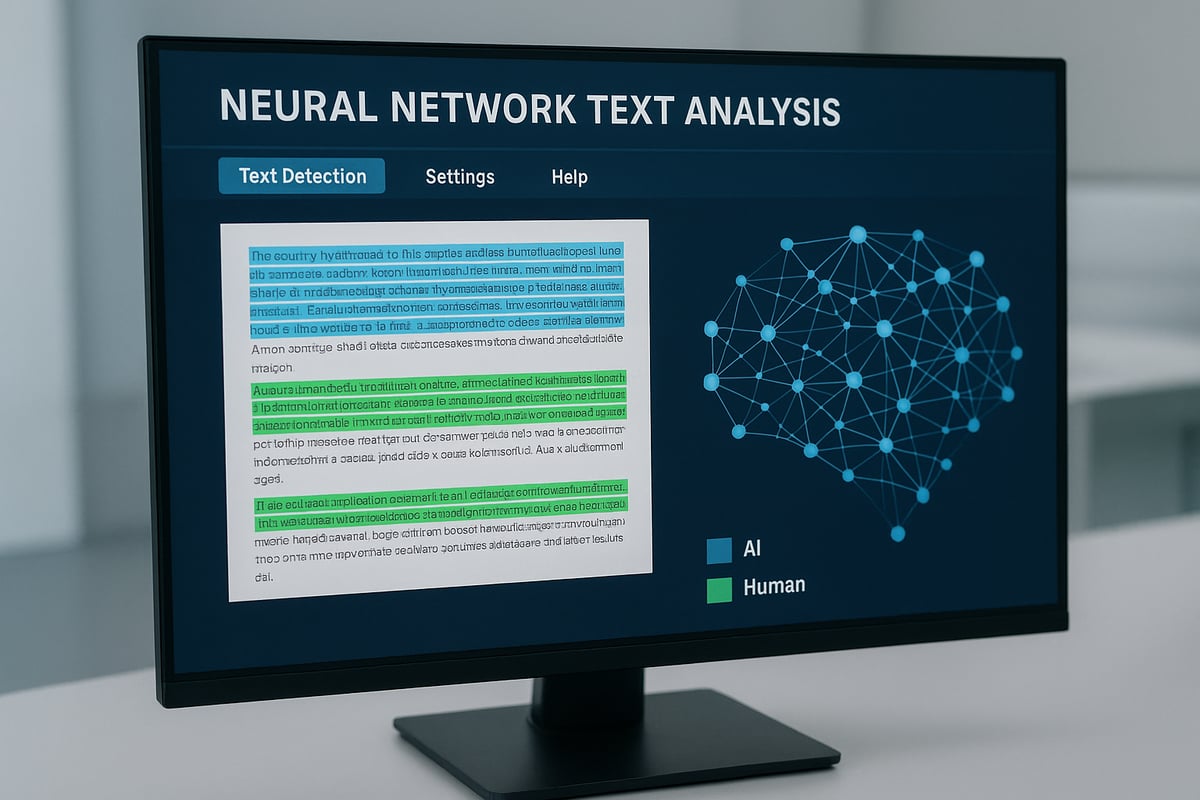
Each sentence or document receives a probability score indicating how likely it is to be AI-generated. Some platforms offer both sentence-level and document-level analysis, providing granular insight.
For example, educational tools might flag entire essays or highlight specific sentences for review. Real-time detection is increasingly common, giving users immediate feedback on content authenticity.
Step 5: Post-Processing and Reporting
After detection, the next phase in how neural networks identify AI text involves post-processing and reporting. Results are aggregated to ensure transparency and clarity for end users.
Detection scores are visualized using dashboards or highlighted text, making it easy to spot suspect sections. Editorial workflows benefit from actionable feedback, such as suggestions for further review or content revision.
This transparent reporting fosters trust in the detection process. Editors, educators, and businesses can quickly identify which parts of a document require closer scrutiny before making final decisions.
Step 6: Continuous Learning and Model Updating
The final step in how neural networks identify AI text is continuous learning. The AI landscape is always changing, with new generative models and writing styles emerging regularly.
To stay effective, neural networks must be retrained with updated datasets that reflect the latest trends and adversarial tactics. Regular benchmarking and evaluation ensure ongoing accuracy.
By monitoring new AI writing patterns and rapidly updating models, neural networks maintain their edge in detection. This adaptability is key for long-term success in the fight against increasingly sophisticated AI-generated content.
Key Features Neural Networks Use to Distinguish AI Text
As the digital world evolves, understanding how neural networks identify AI text is crucial for maintaining authenticity and trust. These advanced systems leverage a variety of detection features to separate human writing from machine-generated content. Let us explore the five core characteristics neural networks analyze when flagging AI-generated text.
Linguistic Fingerprints of AI-Generated Content
One of the first ways how neural networks identify AI text is by searching for unique linguistic fingerprints. AI-generated writing often shows overuse of certain phrases and unnatural repetition, especially with complex topics. Unlike humans, AI systems may produce essays with consistent sentence structures and limited stylistic variety.
Neural networks scan for these repetitive patterns. For example, a machine-written article may display high lexical diversity but lack true semantic depth. By comparing writing style and structure, neural networks can flag content that diverges from genuine human expression.
Semantic Coherence and Logical Flow
Another essential feature in how neural networks identify AI text is the assessment of semantic coherence. Human writing typically flows logically, with deep contextual understanding and smooth transitions between ideas. AI-generated content, however, may lack nuanced reasoning or introduce abrupt topic shifts.
Neural networks evaluate the logical progression of thoughts within a document. They look for shallow explanations or disconnected arguments, which are more common in AI-produced text. By analyzing context and flow, these systems distinguish between sophisticated human logic and the mechanical output of language models.
Statistical Patterns and Anomalies
Statistical analysis plays a key role in how neural networks identify AI text. These models examine word frequency distributions, n-gram patterns, and sentence lengths to spot anomalies. AI-generated content often exhibits unusual entropy, with outlier punctuation or uniform sentence structures.
For instance, a neural network might notice that sentence lengths remain unusually consistent or that certain rare words are overused. By mapping these statistical features, neural networks build a profile of the text, identifying signs of artificial generation that differ from typical human writing behaviors.
Plagiarism and Source Overlap Detection
A critical part of how neural networks identify AI text is their ability to detect plagiarism and source overlap. AI systems sometimes regurgitate fragments from their training data, leading to content that closely matches existing sources. Neural networks cross-reference new text against massive corpora to ensure originality.
Advanced tools, such as Neural network plagiarism checks, use deep learning to scan for copied passages and subtle rephrasings. This helps editors and educators flag AI-generated material that may not be original, preserving content integrity and academic honesty.
Style, Tone, and Sentiment Analysis
The final dimension in how neural networks identify AI text involves analyzing style, tone, and sentiment. AI-generated content often maintains a consistent tone, lacking the emotional nuance and creative flair found in human writing. Sentiment may remain flat, and expressions of humor or irony are less frequent.
Neural networks evaluate these subtleties by comparing the emotional range and stylistic shifts within a document. For example, customer reviews written by AI may sound neutral and generic, while human testimonials feature genuine variability and expressive language. This analysis helps ensure content reflects authentic human perspectives.
Real-World Applications and Tools for AI Text Detection
The landscape of AI-generated content is rapidly expanding, making robust detection essential across industries. Understanding how neural networks identify ai text empowers professionals to safeguard authenticity, ensure compliance, and uphold integrity.
Educational Integrity and Academic Use Cases
Academic institutions face mounting challenges as students increasingly leverage generative AI tools. Educators must know how neural networks identify ai text to maintain academic honesty and fair assessment.
Universities now integrate neural network detectors to scan essays, reports, and research papers. These tools flag potential AI-generated passages, allowing teachers to focus on critical thinking and originality.
Automated grading systems assess the likelihood of AI authorship.
Authenticated reporting supports transparent communication with students.
Policy frameworks reference neural network detection results for fairness.
For more practical strategies, educators can explore AI detection insights for teachers, which details actionable steps for classroom use.
Editorial and Publishing Workflows
Journalists and publishers rely on neural networks to protect content credibility. Knowing how neural networks identify ai text enables editors to spot fabricated news, manipulated quotes, or ghostwritten articles.
Editorial teams deploy detection tools as part of their review process. These platforms analyze submissions, highlight suspicious segments, and generate detailed authenticity reports.
Streamlined editorial workflows reduce manual review time.
Sentence-level analysis pinpoints sections requiring further scrutiny.
Integrated dashboards help maintain high editorial standards.
By embedding detection early, publishers ensure trust with their audience and uphold journalistic ethics.
Corporate and Legal Compliance
Corporations and legal teams must verify the integrity of critical documents. Understanding how neural networks identify ai text is key for compliance, contract authenticity, and regulatory reporting.
Detection solutions scan business communications, financial reports, and legal filings for AI-generated content. This helps organizations reduce risks related to misinformation or fraudulent documentation.
Automated compliance checks support regulatory requirements.
Audit trails document detection results for accountability.
Real-time alerts notify stakeholders of suspect content.
As regulations evolve, neural network-based detection is becoming a standard part of corporate governance.
Detector AI: Advanced Neural Network Detection Solutions
Detector AI exemplifies how neural networks identify ai text at scale. Its advanced platform uses state-of-the-art models to analyze style, vocabulary, and originality in real time.

Key features include:
Sentence-level detection for pinpoint accuracy.
AI vocabulary recognition to spot generative patterns.
Plagiarism checks and source matching for originality assurance.
Trusted by over 1,000 professionals, Detector AI streamlines verification for educators, editors, and businesses. Editors, for example, use Detector AI to confirm article authenticity before publication, ensuring only genuine work reaches their readers.
Emerging Tools and Open-Source Solutions
The field is evolving with a range of tools addressing how neural networks identify ai text. Popular platforms like OpenAI’s AI Text Classifier and GPTZero offer accessible solutions for diverse users.
Open-source libraries enable organizations to customize detection for unique needs. These tools often provide:
Modular architectures for integration into existing systems.
Transparent reporting and explainability features.
Community-driven improvements to keep pace with new AI models.
Comparing accuracy rates, feature sets, and accessibility helps users select the right solution for their context, supporting widespread adoption of AI text detection.
Challenges and Limitations in Neural Network-Based AI Text Detection
As AI-generated content evolves, so do the hurdles in keeping detection methods accurate and reliable. Let's examine the main challenges facing how neural networks identify ai text in 2026.
Evolving AI Model Sophistication
In 2026, generative AI models like ChatGPT-5 and Gemini Ultra have become remarkably adept at mimicking human writing. This rapid advancement complicates how neural networks identify ai text, as the boundary between human and machine language blurs. Neural networks must constantly adapt to new linguistic tricks and nuances introduced by state-of-the-art AI. Ongoing research, such as that highlighted in the AI detection research blog, explores novel techniques to keep detection ahead of evolving models. The arms race between creators of generative AI and detection systems is more intense than ever.
False Positives and Negatives
One persistent challenge in how neural networks identify ai text is the risk of misclassification. False positives occur when authentic human writing is flagged as AI-generated, while false negatives let machine-crafted content slip through undetected. Such errors can undermine trust in detection tools, causing frustration for students, professionals, and editors. Fine-tuning models to reduce these mistakes is an ongoing process, requiring extensive validation. Balancing sensitivity and specificity is crucial to ensure fair and accurate results in real-world applications.
Dataset Bias and Generalization
The effectiveness of how neural networks identify ai text depends heavily on the quality and diversity of training datasets. Bias can creep in if datasets overrepresent certain languages, genres, or writing styles. For example, models trained primarily on English text may struggle to generalize across other languages or specialized domains. Addressing these limitations is a major research focus, as outlined in Text Recognition using Deep Learning: A Review. Diverse, representative data is essential for building detection systems that perform reliably across contexts.
Adversarial Attacks and Evasion Techniques
Another major limitation in how neural networks identify ai text is the ongoing development of adversarial tactics. Users intent on bypassing detection may employ paraphrasing tools, inject noise, or subtly modify AI-generated outputs. These evasion techniques force detection models to become more robust and adaptive. Researchers are actively developing countermeasures, leveraging continual learning and dynamic model updates. The cat-and-mouse game between evasion and detection remains a central challenge in the field.
Ethical and Privacy Considerations
While improving how neural networks identify ai text is vital for content integrity, ethical and privacy concerns must be addressed. Automated detection raises questions about user consent, transparency, and data security. Striking a balance between effective monitoring and respecting individual rights is paramount. Organizations are adopting transparent reporting practices and seeking user buy-in to foster trust. As detection technologies advance, ongoing dialogue about ethical standards remains essential.
The Future of Neural Network AI Text Detection: Trends for 2026 and Beyond
The landscape of AI-generated content is rapidly evolving. As we look to the future, advancements in how neural networks identify ai text will reshape detection strategies. Organizations and professionals must stay ahead by understanding the upcoming trends, tools, and industry shifts that define 2026 and beyond.
Multilingual and Cross-Domain Detection
In 2026, a primary focus is expanding detection across languages and content types. Neural networks are being trained to spot AI-generated text in not only English but also languages like Mandarin, Spanish, and Arabic. This multilingual capability is vital as generative AI tools become globally accessible.
Cross-domain detection is equally important. Neural networks now analyze code, poetry, legal contracts, and even scientific data. Leveraging techniques from Artificial Neural Network Technology for Text Recognition, researchers are refining how neural networks identify ai text across these varied formats. The future demands flexible, adaptable models ready for any content.
Integration with Content Creation Platforms
Another trend is seamless integration of detection tools into writing and publishing platforms. Real-time analysis within word processors, CMS, or email clients helps users ensure authenticity as they write. Instead of manual post-editing, detection becomes a natural part of content creation.
Imagine Google Docs or Microsoft Word providing instant feedback on potentially AI-generated passages. This embedded approach not only improves productivity but also raises the standard for transparency. As how neural networks identify ai text improves, these integrations will become industry norms.
Human-AI Collaboration and Explainability
Transparency and explainability are at the forefront of detection innovation. Modern neural networks do not merely flag suspect text—they also provide clear reasoning and visual cues for their decisions. Dashboards may illustrate which features led to a certain classification, empowering users to review and understand the process.
This collaboration between humans and AI is crucial. By understanding how neural networks identify ai text, users can make informed judgments rather than relying blindly on automated results. Explainable AI bridges the gap between technical sophistication and practical trust.
Continuous Innovation and Industry Standards
The future of AI text detection depends on ongoing innovation and standardized practices. Industry leaders, academic institutions, and regulators are working together to establish benchmarks and certification protocols. These efforts ensure that detection tools remain reliable and widely accepted.
Market research, such as the AI Content Detection Software Market Size & Share 2025-2032 report, highlights rapid growth and evolving requirements in this sector. As how neural networks identify ai text becomes more advanced, adherence to industry standards will be essential for global adoption and trust.